

Smurfing Risks: How Travelers Get Caught in Money Laundering
Money laundering disguises illegally obtained funds to make them appear legitimate. Smurfing, or structuring, is a common but often misunderstood tactic. Travelers, small businesses, nonprofits, humanitarian teams, and faith-based organizations that move people or funds across borders face real risks that often go unnoticed until problems arise.
This article outlines how smurfing works, why travelers and resource-limited organizations are vulnerable, and practical steps to reduce risk. The aim is to support informed decisions, not create fear.

What Smurfing Really Means in Money Laundering
Smurfing involves deliberately dividing large sums of cash or monetary instruments into smaller amounts that remain below reporting thresholds. The term originates from cartoon characters who worked collectively to achieve a goal. In financial crime, this means using multiple individuals or small transactions to move money that would otherwise draw scrutiny.
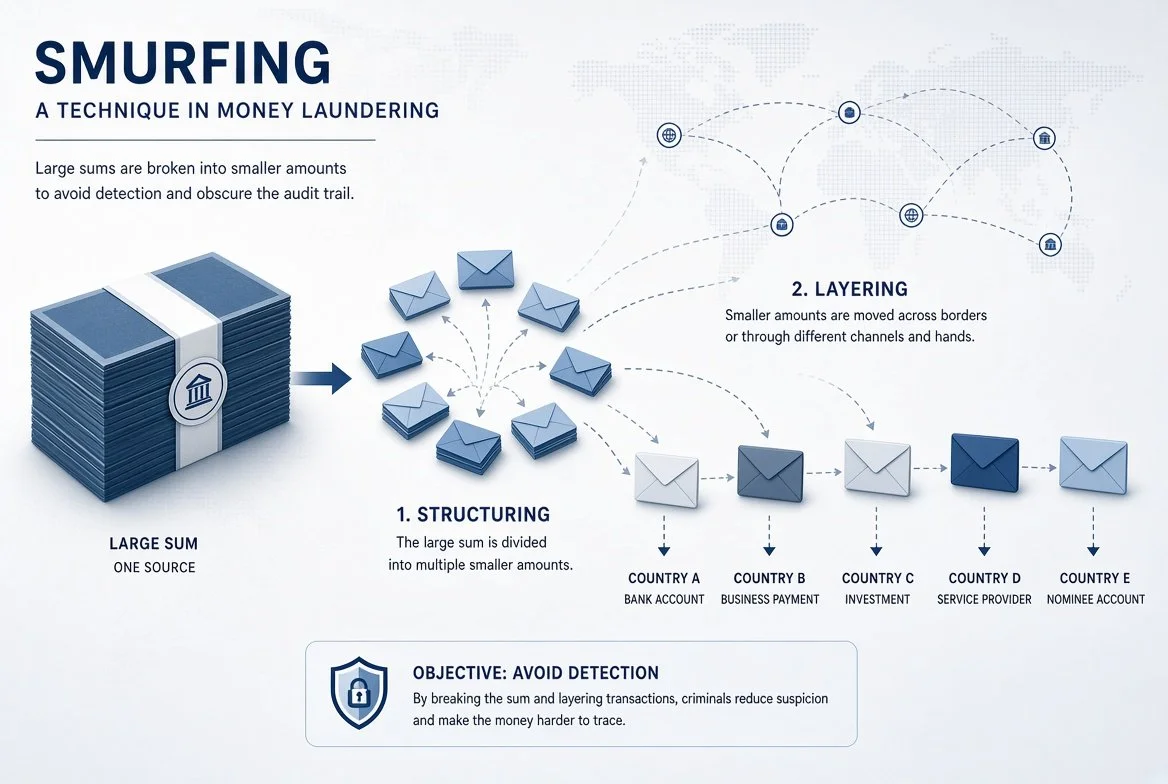
In the United States, anyone entering or leaving the country with more than $10,000 in currency or monetary instruments (cash, certain checks, money orders, traveler’s checks, etc.) must file a FinCEN Form 105 with Customs and Border Protection. Many other countries maintain similar or lower thresholds. When a traveler or group deliberately divides funds so that no single person or single movement exceeds the threshold, and the purpose of the division is to avoid the report, that is structuring. The underlying money does not have to be dirty for the structuring offense to apply. Intent to evade the reporting requirement is enough.
This tactic is central to the layering stage of money laundering. After funds enter the financial system, they are moved through small, routine transactions to obscure the audit trail. Travelers are valuable in this process because they are mobile, often carry cash for legitimate reasons, and can cross borders with less scrutiny than commercial shipments.
Understanding the mechanics is the first layer of Protective Intelligence. When you know what the adversary is trying to accomplish, you can recognize the request that does not quite fit and the pattern that should raise a quiet flag.
The Three Stages of Money Laundering and Where Travelers Fit
Money laundering generally follows three stages: placement, layering, and integration.
Placement refers to introducing illicit cash into the financial system. Large deposits attract attention, so criminals seek methods to deposit funds without triggering scrutiny from a single large transaction.
Layering involves moving funds through multiple accounts, transfers, or physical carriers to obscure their origin. Smurfing is part of this stage. For example, travelers asked to carry or deposit amounts just below reporting thresholds are participating in layering, whether intentionally or not.
Integration is the final step in which the cleaned funds re-enter the legitimate economy as business revenue, real-estate purchases, or investment returns.
Travelers are most commonly used during the layering stage. Humanitarian workers, faith-based staff, or small-business employees may be asked to carry funds as a favor or practical necessity, often with little explanation or documentation. Requests are typically framed as, “Can you just take this for me? It’s under the limit.”
For organizations sending personnel abroad, the risk is both organizational and personal. Detention or charges against one staff member can disrupt programs, harm reputation, and expose the organization to legal liability if proper briefings were not provided.
How Unsuspecting Travelers Get Drawn Into Smurfing Schemes
The most frequent scenarios appear deceptively routine.
A colleague or acquaintance may ask a traveler to carry cash or a monetary instrument across a border, citing convenience or slow banking processes. The amount remains just below the reporting threshold, and no receipt or clear documentation is provided to clarify the nature of the funds.
Groups may be instructed to divide cash so no individual exceeds the limit. Under U.S. rules, the $10,000 threshold applies to the group’s total when acting collectively. Splitting funds does not ensure legality and may constitute an offense.
In cash-heavy environments such as humanitarian operations, informal economies, or regions with limited banking infrastructure, staff may be asked to move project funds in ways that resemble structuring. Without clear internal controls and documentation, distinguishing between legitimate necessity and criminal structuring is difficult after the fact.
Key point: Dividing money among travelers does not make the transfer legal if the intent is to avoid reporting thresholds and the source cannot be clearly documented. The main legal concerns are the origin of the funds and the intent behind the structuring.
These situations typically occur when individuals are trying to be helpful or when organizational cash-handling procedures are informal. In this context, Protective Intelligence requires treating unusual requests to move money with the same caution as unusual requests to transport packages.
The Real Consequences for Innocent People and Organizations
Even if the traveler is unaware of any underlying crime, the consequences can be severe.
Criminal charges for structuring or money laundering may result. Lack of knowledge is not always a sufficient defense, especially if the traveler followed instructions intended to avoid reporting.
Asset seizure is common. Authorities may confiscate funds during an investigation. Recovering the money requires proving legitimate ownership and source, which is often costly and time-consuming.
Travel disruptions can occur rapidly. Detention at the border, missed flights, canceled programs, and legal proceedings in a foreign jurisdiction create immediate operational and personal challenges.
Reputational damage can persist. Being named in a money-laundering investigation, even if cleared, may affect future visas, employment, and organizational partnerships.
For small organizations and nonprofits, secondary effects often outweigh the individual case. Program delays, donor inquiries, insurance complications, and legal costs can strain limited resources far more than they would for large corporations.
These outcomes are not theoretical. They occur frequently enough that financial-crime awareness should be included in any comprehensive Travel Risk Management process.
Practical Defenses for Travelers and Resource-Limited Teams
Defensive measures are straightforward and cost-effective.
Understand the thresholds. Before traveling, identify currency reporting requirements for each country of departure, transit, and arrival. The U.S. $10,000 rule is only one example; many countries have lower limits or different definitions of monetary instruments.
Declare funds when required. If the amount meets or exceeds the threshold, submit the appropriate report. Filing the form is a compliance measure, not an admission of wrongdoing.
Document the source of funds. Maintain clear records such as invoices, gift letters, board authorizations, or project budgets to establish the legitimacy and purpose of the funds. Digital copies accessible offline are helpful if paper records are seized or questioned.
Question unusual requests. Any request to carry or transfer funds for another person should prompt an internal review. Determine ownership, necessity of physical transport, and possible alternatives. Organizations should provide staff with explicit permission and a straightforward process to decline such requests without career repercussions.
Treat group travel as a single unit for reporting purposes when the funds are related. Do not assume that splitting cash among several people creates legal cover.
Build a short pre-travel financial checklist into existing travel procedures. It does not need to be elaborate: thresholds, documentation requirements, approved methods for moving project funds, and a point of contact for questions.
These steps serve as a practical decision-making tool. They are inexpensive to implement and address most risks that could turn a routine trip into a legal issue.
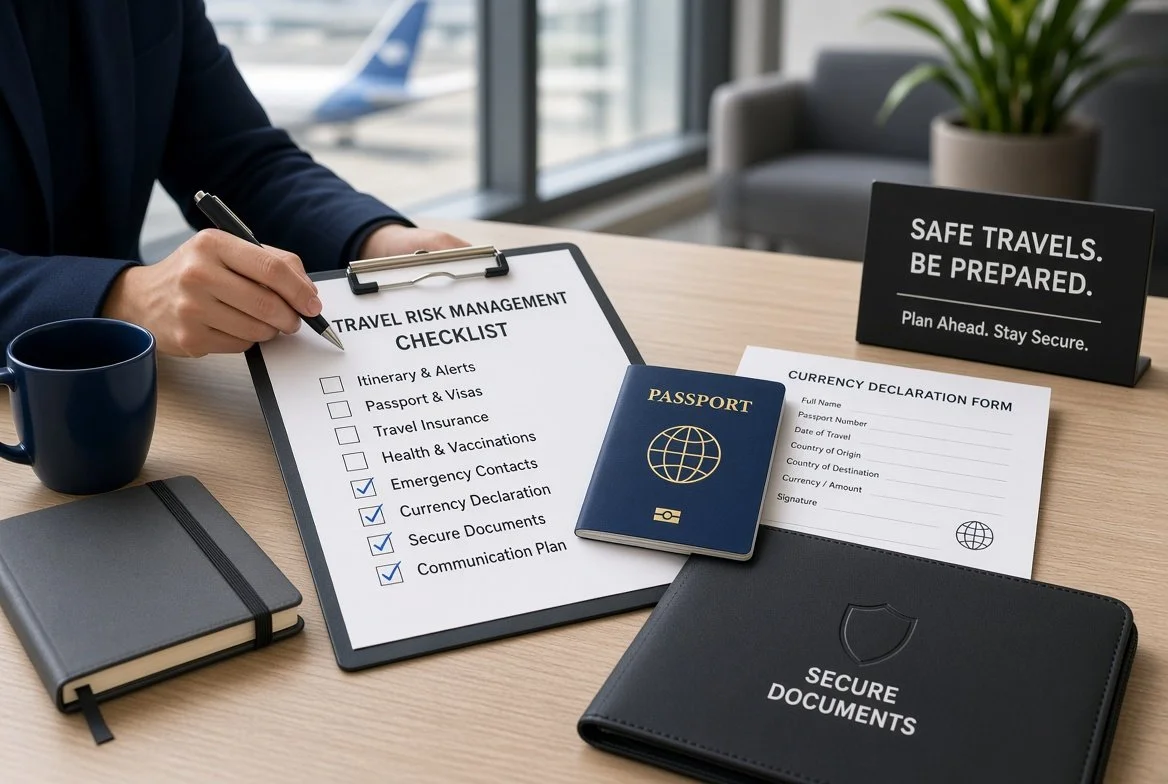
Financial crime risk is closely linked to physical and operational risk. A traveler detained over cash cannot complete their mission, and an organization whose funds are seized mid-project faces disruptions similar to those caused by security incidents.
Protective Intelligence includes watching for indicators that financial movement is being used as a layering channel. Unusual requests, pressure to avoid documentation, or repeated small transfers that lack clear business purpose are signals worth examining.
For small organizations, integration is straightforward. Add a financial-crime awareness module to travel briefings, provide staff with a one-page reference on thresholds and documentation, and establish a clear internal channel for reporting concerns. Review insurance policies for coverage of legal defense and asset seizure related to currency reporting issues, as many policies may be limited in this area.
The same disciplined attention to indicators that protects against physical threats also safeguards against financial risks. Early recognition and prompt action are the most effective tools available.
Smurfing succeeds when ordinary individuals serve as convenient, low-scrutiny carriers. It fails when travelers and their organizations treat money movement with the same seriousness as other travel risks.
Need Practical Support?
Morton Executive Decisions works with small and mid-sized commercial companies, nonprofits, humanitarian organizations, and faith-based groups that need professional-grade Protective Intelligence and Travel Risk Management without large internal infrastructure.
If your teams move people or funds across borders and you seek clearer protocols, improved pre-travel briefings, or a practical review of your current procedures, please contact us. Often, a brief conversation is sufficient to identify the most impactful improvements using your existing resources.